


During a pandemic, many of us have been suffering from severe disease and fighting with our lives. It was the worst scenario when the patients were near to death but recovered from the coronavirus. Who kept us so safe and motivated during the critical situation? Obviously, nurses, right! They were the one who was apart from their families and pushing their lives into a terrifying risk. They worked hard whole day and night only to recover their patients and keep them alive safely.
The nurses learn all these crucial things in their education life through the nursing clinical reasoning cycle. This learning taught them the process of every human body that starts from childhood, where analytical thinking, judgment capability, and reasoning based on two or more decisions come around. Being a nursing student, you also have to study the clinical reasoning cycle by Tracy Levett-Jones. Sometimes, students do not understand the concepts and steps of the topic and fail to complete their academic papers, which leads them to get bad grades in the end. It is the reason they look for assignment writers who assist them in drafting their document flawlessly and assures them of getting an A+.
Let us read this blog to know more about the clinical reasoning cycle.
What Is the Nursing Clinical Reasoning Cycle?
A Nursing Clinical Reasoning Cycle is a process that every nurse and the healthcare sector has to follow to take care of the patient. This process includes various applications such as collecting data, converting fresh data into information, understanding the patient's situation by looking at their past reports, planning the treatment and implementing it, measuring the outcomes, and working accordingly. To perform the clinical reasoning cycle thoughtfully, you have to ensure that your thinking process is sorted or not. In this sector, you have to be very careful while analyzing every phase of the process, as the experts need clear and accurate reports. You must ensure that the skilled authorities can differentiate between the two judgments and come up with an anonymous decision known as reasoning ability. It is the responsibility of the nurse to understand the human judgments, attitudes, and philosophical views, calculate the interventions of the patient to evaluate the outcome of the process. The method helps nurses know if the patient can recover from the particular disease or the situation can worsen. Nurses have to be prepared with a backup plan to avoid the consequences, or the patient has to suffer. It may cause life-threatening outcomes to the patient's life, and thus, nurses must know the process of the clinical reasoning cycle accurately.
Till now, you must be aware of how vital the clinical reasoning cycle is for the nurses and patient's life. Now let us read about the information that how the nursing students deal with this topic and grasp some helpful information about the nursing clinical reasoning cycle.
How Do Nursing Students Deal with this Topic?
In the clinical reasoning cycle process, nurses have to operate the patient's mental health step by step to critically analyzing the decision. After this, a particular treatment is given to the patient in which nurses use and apply clinical reasoning and critical judgment to ensure that the patient is treating without any health risk and consequences.
According to the above details, the clinical reasoning cycle helps the wellness sectors to analyze their planning, evaluate their opinions and see whether the treatment is working accurately to provide a qualitative experience. It also showcases the decision-making skills of clinicians and nurses. No matter what, training is vital for the students to be skilled enough in the particular sector and learn how to make a critical judgment.
Tracy Levett-Jones introduced the theory of the nursing clinical reasoning cycle. He was a renowned professor in the nursing school of Newcastle. He states that this process is divided into 8 steps and the nurses have to follow all the steps to treat the patient carefully. This process is followed by every physician, wellness sector, nurse, and clinician. If you are pursuing the nursing course, you also have to study these concepts and know the importance of the clinical reasoning cycle. It helps nurses take care of the patient personally and think logically and critically while treating the sufferer.
Let us read about the eight steps of the clinical reasoning cycle so that you can smoothly recover the patient from the particular disease. We all understand that clinical opinions are used in every healthcare sector, and thus we must know the process that works to improve the patient's condition. It will help nurses to make an accurate decision in the particular treatment for the patient's wellness.
What Are the 8 Steps of the Clinical Reasoning Cycle?
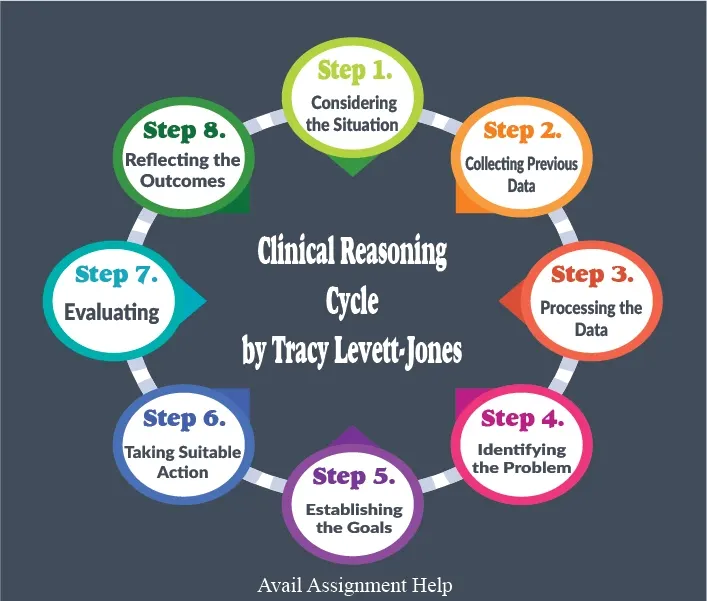
The wellbeing and healthcare sector requires a specific plan and process to treat the patient, and thus the nurses use this clinical judgment to prepare the accurate treatment plan and achieve their end result. There are 8 steps of the nursing clinical reasoning cycle by Tracy Levett-Jones, and every step holds a critical value in the life of patient and nurse equally.
Let us read the following steps to know more about the clinical reasoning procedure and understand the concepts.
Step 1: Considering the Situation of the Patient
The first step is to examine the current situation of the patient. In this step, nurses collect the facts and details from the patient regarding his current medical state. They gather all the data related to the patient's health issues and submit the report to the hospital. The experts of Avail Assignment Help say that this step must be informative and systematic to get every piece of information about the sufferer. It will help the nurse to treat the patient in a suitable manner.
Step 2: Collecting Previous Data
The second step is to review the medical history of the patient. After considering the current situation, the nurse checks all the clinical operations, surgeries, medical plans, treatment processes, and results of all the test done in his previous life. On all this information, the nurse requires to make judgments based on physiology-related and pharmacology knowledge. The nurse checks whether the patient's earlier reports show any side effects, symptoms, medications, and other steps while recording the specific data.
Step 3: Processing the Data
The third step is the most vital one in the whole process of the clinical reasoning cycle. After examining all the past reports of the patient, the nurse notes the current health situation and then processes the data in pharmacological and pathological patterns. After this, you have to distinguish the relevant information, and while doing so, you have to keep in your mind the potential results and decisions you will make. The collected data is processed to determine whether the patient has any hypertension, body temperature, or blood loss problem. The changes will be recorded, and the nurse will report to the hospital.
Step 4: Identifying the Problem
The fourth step is to identify the problem and create a diagnostic report of the patient's health problem so that the nurse can consider all the facts and data accurately. It is the step that will help you to identify the exact reason behind the patient's problem.
Step 5: Establishing Goals
The fifth step helps the nurses in discovering the goals of the patient. As per the current health status, the nurse makes some goals towards the diagnosis process and defines a plan for further treatment in the particular span. If you already know your next step, it will be way more than easier to achieve your target smoothly. If you think that the patient has a hypertension issue, you should plan a treatment to maintain the average level.
Step 6: Taking Suitable Action
The sixth step is to take necessary action so that the nurse and the entire healthcare sector team will implement the treatment as per the decided goals and objectives. These actions will help in bringing the desired results to the patient's disease.
Step 7: Evaluating
The seventh step is to estimate the results. The wellness and nursing sectors must estimate and evaluate the results after implementing the plans specifically. All the parameters should be measured to see how helpful the nursing care was, and then your situation will be judged based on the particular treatment plan, and the outcomes will be recorded.
Step 8: Reflecting the Outcomes
The eighth step is to reflect all the end results and make the proper report. You have all the data and other discoveries at the time of the whole process, and you have to examine it to perform this last step. It will help you reduce the chances of having mistakes in the future. For this, the nurse checks all the other possible ways that could help the patient in improving his health issues effectively.
These are the 8 steps of the clinical reasoning cycle by Tracy Levett-Jones. So being a nursing student, you have to take care of all the steps and perform smoother operations so that you can provide the best nursing facility to the patient.
However, if you do not find the above information helpful, then you can contact our customer care executive and get assistance at any hour of the day. You can also avail of assignment writing services from the renowned experts of Australia that too at affordable rates. Now, getting an A+ in the hectic schedule is more leisurely; reach out to our experts and get all your academic papers done with top-notch quality content and error-free. You need not worry about the copied content, as the experts conduct a thorough research about the given topic and then work as per the requirements of the students. They write the document on their own and do not copy content from any resource. So, what are you waiting for? Quickly visit the website and place your order to get the desired grades in your assignment writing tasks.
You May Also Like to Read:
EVERYTHING YOU NEED TO KNOW ABOUT FEATURE ARTICLE
HOW TO WRITE A DISCUSSION ESSAY? GRADE WINNING TIPS!